For a long time, I believed that my challenges in business and the share market were mainly due to strategy, capital, or external conditions. I kept searching for better systems, better indicators, and better opportunities.
Over time, a quieter realization emerged.
Certain inner patterns and decision-making habits were consistently influencing my results — even though I wasn’t consciously aware of them.
What surprised me most was this:
I could easily notice these patterns in others, especially friends running businesses or trading actively. Their hesitation, overconfidence, or inconsistency was visible to me.
But when it came to my own decisions, clarity was missing.
This blog is a reflection on that blind spot — and how I began working with it rather than fighting it.
The Blind Spot We Rarely Notice
Most of us observe others objectively. There is emotional distance, so patterns appear clearly.
When we observe ourselves, however:
- Past experiences are involved
- Fear of repeating old mistakes is present
- Expectations quietly influence decisions
Because of this, our own decision patterns operate in the background, unnoticed.
In business and trading, these unseen patterns often matter more than skill or knowledge.
Why the Share Market Makes This More Visible
The market responds immediately to decisions. There is no buffer.
Every trade brings:
- Uncertainty
- Risk
- Feedback
This makes the market a powerful mirror.
It reflects:
- Caution as early exits
- Doubt as missed opportunities
- Hope as delayed exits
- Past experiences as hesitation
Especially when capital is limited, decisions start carrying emotional weight. Each action feels significant, and clarity becomes harder to access.
A Subtle but Important Insight
The challenge is not about personality or character.
It lies in unnoticed decision patterns that repeat under pressure.
These patterns often look like:
- Seeking certainty before acting
- Protecting capital emotionally instead of statistically
- Avoiding small discomfort, even when rules are clear
- Measuring success only by outcomes, not by execution
Once these patterns become visible, change becomes possible.
Working With Patterns Instead of Fighting Them
1. Shifting Focus from Self-Change to Structure
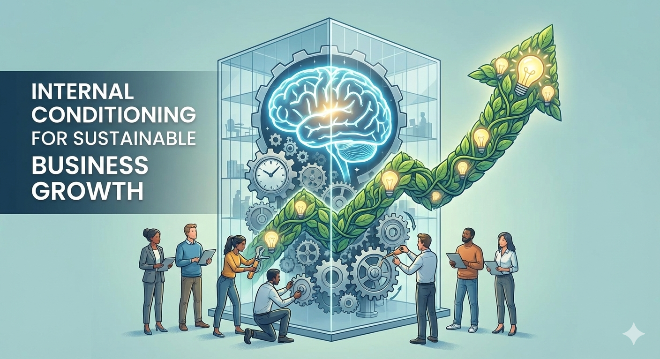
Instead of trying to “fix” ourselves, it helps to build structures that support calm decision-making.
Clear rules, defined risk limits, and predefined actions reduce the need for emotional effort.
Structure doesn’t remove emotion — it reduces its influence.
2. Creating Space Between the Person and the Process
One helpful approach is to separate:
- The human side, which naturally reacts
- The operator side, which follows a process
The operator focuses on:
- Executing predefined rules
- Accepting outcomes without interpretation
- Measuring consistency rather than profit
This separation brings relief and clarity.
3. Using Small Risk to Restore Ease
When decisions feel heavy, reducing risk can be powerful.
Smaller position sizes allow:
- Clearer thinking
- Better observation
- Less emotional attachment to outcomes
Over a series of trades, confidence slowly returns — not from profit, but from consistency.
4. Making Patterns Visible Through Simple Records
Awareness grows faster with evidence.
A simple journal can help:
- Was the rule followed?
- What feeling was present?
- Was there an urge to deviate?
Over time, repeated responses become visible.
What was once invisible becomes clear.
Redefining What Progress Looks Like
Progress is often measured by financial results.
But sustainable growth usually comes from:
- Calm execution
- Repeated consistency
- Reduced internal friction
When process improves, outcomes tend to follow naturally.
A Quiet Realization
Those difficult years were not wasted.
They were years of experience without structure.
With structure, experience begins to work for you rather than against you.
A Small Daily Reflection
Before starting the day, ask:
“If I approach today without the weight of past outcomes, what is the most balanced action?”
This simple question gently brings attention back to the present.
Closing Thoughts
There is nothing wrong with you.
What’s often needed is:
- A safer way to make decisions
- Clearer structures
- And patience with gradual improvement
When inner patterns become visible, change happens quietly — without force.