For most salaried professionals, the search for additional income often leads to the stock market. Among the many options available, equity investing and futures trading stand out. Both can generate returns, but they carry very different levels of risk. To make smart choices, it’s essential to analyze their impact on your capital and long-term financial health.
Equity Trading – The Steady Builder
When you buy equity (shares), you become part-owner of a company. Your returns come from:
- Capital Appreciation (share price rising)
- Dividends (cash distribution from profits)
- Compounding wealth over the long term
Example – Equity Investment
- Infosys price = ₹1,500
- Capital Available = ₹1,50,000
- Shares Bought = 100
👉 If Infosys rises to ₹1,560 (+₹60):
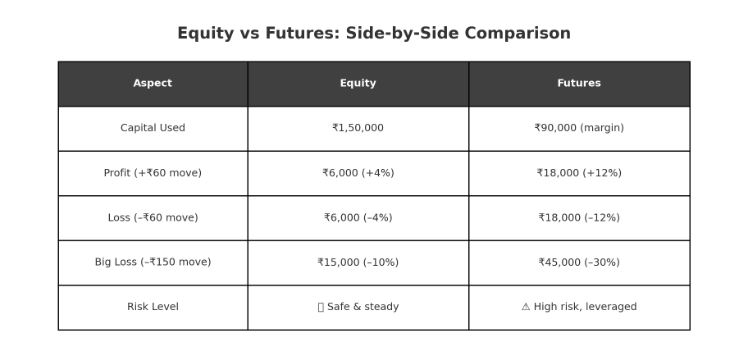
- Profit = 100 × 60 = ₹6,000
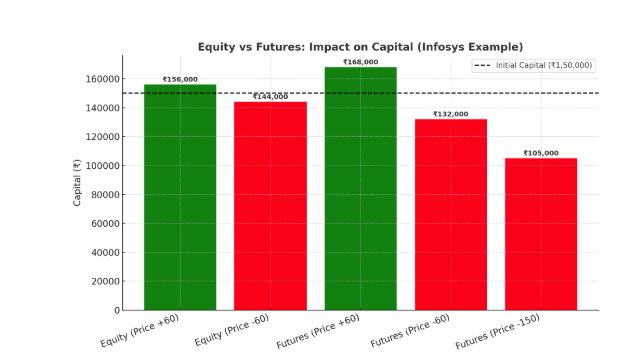
- New Capital = ₹1,56,000 (+4%)
👉 If Infosys falls to ₹1,440 (–₹60):
- Loss = 100 × 60 = ₹6,000
- New Capital = ₹1,44,000 (–4%)
✅ Impact on Capital: Moderate gains/losses. Suitable for salaried people who want steady growth without heavy monitoring.
Futures Trading – The Double-Edged Sword
Futures are contracts where you agree to buy/sell shares later at today’s price. The advantage is leverage: you only put up a margin (around 20%) but control a much larger position.
Example – Futures Investment
- Infosys price = ₹1,500
- Lot size = 300 shares
- Margin required (20%) = ₹90,000 (from your ₹1,50,000)
👉 If Infosys rises to ₹1,560 (+₹60):
- Profit = 300 × 60 = ₹18,000
- New Capital = ₹1,68,000 (+12%)
👉 If Infosys falls to ₹1,440 (–₹60):
- Loss = 300 × 60 = ₹18,000
- New Capital = ₹1,32,000 (–12%)
⚠️ Impact on Capital: Faster growth, but also faster destruction. The same price move caused only –4% loss in equity but –12% loss in futures.
Worst-Case Capital Risk in Futures
If Infosys falls by 10% (₹1,500 → ₹1,350):
- Loss = 300 × 150 = ₹45,000
- New Capital = ₹1,05,000 (–30%)
👉 A salaried person could lose 3 months’ savings in a single trade if not disciplined.
Risk Management for Salaried Investors
Whether you trade in equities or futures, remember: capital protection comes first.
- 📌 Position Sizing – Don’t risk more than 5–10% of your capital in one trade.
- 📌 Stop-Loss – Predetermine exit levels to limit losses.
- 📌 Diversification – Use equities for long-term growth, futures only for hedging or small tactical bets.
- 📌 Emergency Fund – Keep 6–12 months of living expenses separate from trading capital.
Investor’s Balanced View
- Equity = Safer, long-term wealth builder, lower risk.
- Futures = High-risk, high-reward, needs active monitoring.
- Best Approach for Salaried Professionals = Build a strong equity portfolio, and allocate only a small portion of surplus funds to futures trading.
Final Thoughts
For a salaried professional, trading should add to income, not threaten it.
- Use equity to grow wealth steadily.
- Use futures sparingly, with strict risk controls, to capture short-term opportunities or hedge your portfolio.
Always remember: Capital preservation is the first step to wealth creation.